
Last Updated on 22/09/2026 by PetSmartify Editorial Team

(Disclosure: This page contains affiliate links. As an Amazon Associate, we earn from qualifying purchases at no extra cost to you.)
Leaving your pet home alone can be difficult, especially when you know they become restless, vocal, destructive, or distressed as soon as you walk out the door. Smart pet tech for separation anxiety can give pet parents useful ways to monitor their pets, maintain routines, provide enrichment, and reward calm behavior while they’re away, making being home alone a little easier for both pets and their people.
Table of Contents
Can Smart Pet Tech Really Help With Separation Anxiety?
The first thing to understand is that smart technology isn’t a treatment for separation anxiety. However, the right device can support a broader strategy by helping you understand what your pet does when you’re away and giving them appropriate stimulation and predictable routines.
For example, a smart pet camera can show you whether your dog settles down after you leave or spends the entire time pacing and vocalizing. An interactive toy can provide mental stimulation for a pet that becomes bored during the day, while a smart feeder can help maintain a familiar feeding schedule.
The goal isn’t to keep your pet constantly entertained or connected to you through your phone. It’s to create an environment where alone time is predictable, comfortable, and appropriately enriching.
Separation Anxiety or Boredom? They’re Not the Same Thing
Some behaviors that look like separation anxiety can actually be caused by boredom or a lack of stimulation.
Possible signs of separation-related distress include:
- Barking, whining, or howling soon after you leave
- Persistent pacing or restlessness
- Attempts to escape through doors or windows
- Destructive behavior concentrated around exit points
- Accidents that happen primarily when your pet is left alone
- Difficulty settling even after you’ve been gone for a while
Boredom may look more like:
- Chewing household objects
- Scratching or knocking things over
- Seeking attention when you’re home
- Becoming destructive after long periods without activity
- Showing interest in toys, food puzzles, or movement when stimulation is available
These aren’t diagnostic categories, and behavior can have several causes. If your pet is showing severe or persistent distress, speak to your veterinarian or a qualified animal behavior professional. One of the most useful things about a pet camera is that it can help you see what’s actually happening after you leave, rather than guessing.
Quick Guide: Which Smart Pet Tech Could Help with Separation Anxiety?
| If your main concern is… | Smart tech to consider |
|---|---|
| You don’t know what your pet does when you’re away | Smart pet camera |
| Your dog gets bored during the day | Interactive dog toy |
| Your cat needs hunting-style enrichment | Interactive cat toy |
| Your pet responds well to food rewards | Treat-dispensing camera |
| Your pet benefits from a predictable feeding routine | Smart feeder |
| Your home becomes dark while you’re away | Smart lighting |
| You suspect genuine separation anxiety | Camera + behavioral support |
Let’s look at what each type of technology can actually do.
1. Smart Pet Cameras: See What Happens When You Leave
A smart pet camera is arguably one of the most useful pieces of technology for pets that struggle when left alone. Why? Because you can’t help solve a problem you can’t see.
A camera allows you to check whether your pet:
- Settles down shortly after you leave
- Continues pacing or vocalizing
- Sleeps for most of the day
- Becomes destructive
- Responds to sounds or movement
- Engages with toys you’ve left available
Some smart pet cameras also add two-way audio, motion tracking, pet alerts, and treat dispensing, giving you more ways to interact with your pet remotely.
Should You Talk to Your Pet Through the Camera?
Two-way audio can be useful, but it’s worth paying attention to your individual pet’s response. Some pets seem reassured by hearing their owner’s voice. Others become more confused or excited because they can hear you but can’t find you. If your pet becomes more distressed every time you speak through the camera, it may be better to use the camera primarily for monitoring.
Treat Dispensing to Reward Calm Behavior
Treat dispensing can add another useful function to a smart pet camera. Instead of using treats simply to get your pet’s attention, they can be incorporated into a positive-reinforcement routine. For example, imagine your dog normally paces around after you leave. Once they settle calmly on their bed, you can use the treat dispenser to reward that behavior.
The important part is the behavior you’re rewarding. The goal isn’t to repeatedly dispense treats whenever your pet is barking or panicking. Instead, food rewards can be used as part of a broader strategy for reinforcing desirable behaviors. Treat dispensing can also provide a little enrichment during a long day alone.
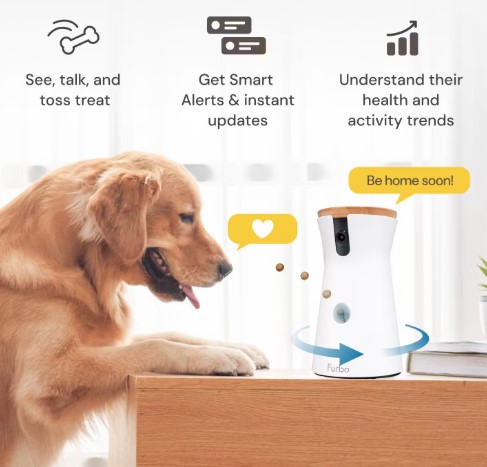
Furbo 360 Smart Pet Cameras
Furbo’s 360° cameras combine monitoring with features designed specifically for pet owners.
Features include:
- 360° rotating 1080P HD camera
- Automatic pet tracking
- Two-way audio
- Remote treat tossing
- Smart pet alerts
Best suited to: Pet parents who want to monitor their pets and interact with them remotely.

– 360° rotating 1080P HD camera
– Auto pet tracking
– 2-way audio
– Remote treat tossing
– Smart alerts
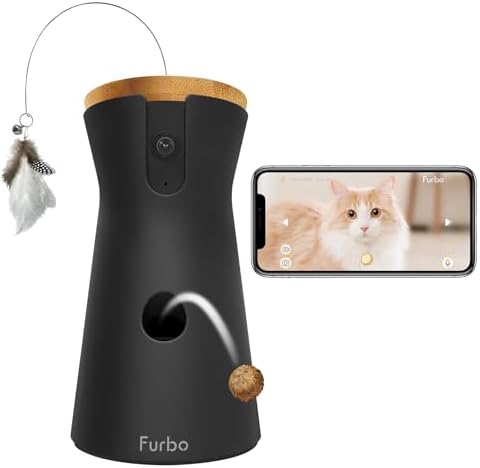
– 360° rotating 1080P HD camera
– Auto pet tracking
– 2-way audio
– Remote treat tossing
– Smart alerts
– Feather wand attachment
👉 Explore our full guide to smart pet cameras with treat dispensers.
A Note About Food Rewards
Treats aren’t appropriate for every pet or every situation. Consider your pet’s diet, weight, allergies, and any veterinary recommendations before adding extra treats to their daily intake.
2. Interactive Smart Toys: Give Bored Pets Something to Do
Boredom can contribute to unwanted behavior, particularly when a pet has little to do during long periods alone. Interactive toys can provide another outlet for your pet’s natural behaviors, such as chasing, batting, investigating, and playing. The idea isn’t to keep your pet moving for hours, it’s to give them opportunities for appropriate mental and physical enrichment.
Cheerble Wicked Ball Rolly
The Cheerble Wicked Ball Rolly is designed to encourage pets to interact with a moving ball.
Features include:
- Three modes: hybrid, spin, and roam
- Motion activation
- 10-minute play/30-minute rest cycles
- Rechargeable battery
- Replaceable outer shell
Best suited to: Dogs that enjoy chasing and interacting with moving toys.

👉 See our full guide to smart interactive dog toys.
Cats have different play preferences from dogs, and many interactive cat toys are designed around movement that encourages stalking, chasing, batting, and pouncing.
ORSDA 5-in-1 Interactive Cat Toy
The ORSDA 5-in-1 provides several different play modes, giving cats more variety when a single type of toy quickly loses their interest.
Features include:
- Five interactive play modes
- Touch activation
- Rechargeable design
- Durable construction
Best suited to: Cats that enjoy varied interactive play.

– Automatic play cycles
– Smart sensor mode
– Rechargeable
– Multiple accessories included
👉 See our full guide to smart interactive cat toys.
3. Smart Feeders: Keep Your Pet’s Routine Consistent
Food can be a powerful part of a pet’s daily routine. If your pet normally eats at particular times, being away from home doesn’t necessarily mean their routine has to disappear.
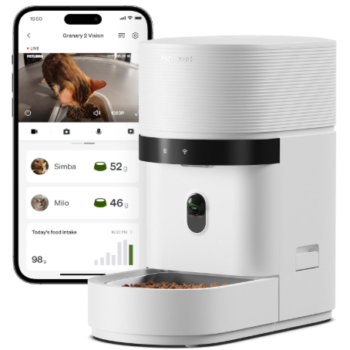
PETLIBRO Granary 2 Vision
A smart automatic feeder can dispense meals according to a schedule, helping maintain consistency even when you’re working long hours or aren’t home for mealtimes.
Features include:
- Camera to check in and watch your pet eat
- Scheduled feeding
- Portion control
- App-based control
- Multiple daily meals
- Feeding notifications
For some pets, having a predictable feeding routine can make the day feel more structured. Automatic feeders can also be useful for pets that tend to wake up early, beg for food, or become restless around mealtimes. However, a feeder shouldn’t be viewed as a treatment for separation anxiety. Its main benefit is routine and convenience.
👉 Explore our smart automatic pet feeders to find feeding technology for different types of pets.
4. Smart Lighting: Keep the Home Environment Familiar
Smart lighting isn’t a treatment for separation anxiety, but it can help you maintain a more predictable home environment while you’re away.
For example, you could schedule lights to:
- Turn on around the time your pet normally expects you home
- Gradually change throughout the day
- Prevent the house from becoming completely dark
- Follow a consistent daily schedule
Smart bulbs can also be controlled remotely if your plans change and you’re going to be away later than expected.
Linkind Smart Light Bulbs
Linkind smart bulbs offer programmable lighting and app-based control.
Features include:
- Alexa and Google Assistant compatibility
- App, voice, and remote control
- Preset scenes
- Time scheduling
- Multiple colors
- Group control
Best suited to: Pet owners who want to automate their home’s lighting routine.
The important thing is consistency. You don’t need an elaborate light show for your pet. A simple, predictable lighting schedule is enough.

- 💡[Smart Bulb that Work with Alexa] Direc…
- 💡[APP Control/Voice Control/Remote Contr…
- 💡[Preset Scenes & Time Schedule] Schedul…
- 💡[Color Changing Smart Light Bulbs] Link…
How to Use Smart Pet Tech Effectively
Buying a smart gadget is only half the equation. How you use it matters.
Introduce new technology while you’re still home
Don’t leave a brand-new automated toy running for the first time five seconds after walking out the door. Give your pet time to investigate it while you’re there.
Don’t overwhelm your pet with gadgets
More technology isn’t necessarily better. A camera, one appropriate enrichment toy, and a predictable feeding routine may be more useful than filling the house with automated devices.
Observe your pet’s reaction
Use your camera to see whether the technology is actually helping.
Is your pet relaxing?
Are they playing?
Are they ignoring the device?
Or are they becoming more agitated?
Let your pet’s behavior guide how you use the technology.
Build predictable routines
Pets often benefit from consistency. Feeding, playtime, walks, enrichment, and departures can all become part of a predictable daily pattern.
Don’t use technology as a substitute for exercise and interaction
A smart toy can’t replace a walk, play session, training, grooming, or time spent with you. Smart technology works best as an addition to good pet care, not a replacement for it.
When Smart Tech Isn’t Enough for Pet Separation Anxiety
If your pet is experiencing genuine separation anxiety, a camera or interactive toy may help you monitor and enrich their environment, but it may not address the underlying problem.
Speak to your veterinarian or a qualified animal behavior professional if your pet shows severe or persistent signs of distress, particularly if they are:
- Injuring themselves trying to escape
- Destroying doors, windows, or other exit points
- Persistently vocalizing when alone
- Having repeated accidents specifically when left alone
- Showing extreme panic or inability to settle
- Becoming increasingly distressed despite environmental changes
Treatment for significant separation-related behavior may involve behavioral modification and, where appropriate, professional or veterinary support. Smart technology can then become part of that overall management strategy.
Frequently Asked Questions
Can a pet camera help with separation anxiety?
A pet camera can help you understand how your pet behaves when you’re away and can provide features such as two-way audio, alerts, and treat dispensing. However, a camera doesn’t treat separation anxiety by itself.
Should I talk to my pet through a pet camera?
It depends on your pet. Some animals may find your voice reassuring, while others may become confused or more excited when they hear you but can’t locate you. Watch their reaction and adjust your use of two-way audio accordingly.
Can interactive toys help with separation anxiety?
Interactive toys can provide mental and physical enrichment and may be particularly useful when boredom contributes to unwanted behavior. They shouldn’t be considered a standalone treatment for severe separation anxiety.
Can a smart feeder help a pet that doesn’t like being alone?
A smart feeder can help maintain a familiar feeding schedule while you’re away. This may make the daily routine more predictable, but it doesn’t directly treat separation anxiety.
Should I leave an automated toy running while I’m away?
Follow the manufacturer’s instructions and consider your pet’s behavior and safety. Introduce the toy while you’re home first, and make sure your pet interacts with it appropriately before leaving them alone with it.
Is pet separation anxiety the same as boredom?
No. Boredom can lead to destructive or attention-seeking behavior because a pet lacks stimulation, while separation anxiety involves distress associated with being separated from their owner or caregiver. The behaviors can overlap, which is why observing your pet while you’re away can be useful.
When should I get professional help?
If your pet experiences severe distress, attempts to escape, injures themselves, persistently vocalizes, or cannot settle when alone, speak to your veterinarian or a qualified animal behavior professional.
The Bottom Line
Smart pet technology won’t magically make separation anxiety disappear, but it can make managing alone time easier. A smart camera can show you what happens after you leave. A treat dispenser can support positive reinforcement. Interactive toys can provide enrichment, while smart feeders can maintain predictable routines. Even smart lighting can help keep the home environment consistent.
The key is choosing technology based on what your pet actually needs, rather than assuming the most expensive gadget will solve the problem. For mild boredom or a pet that simply needs more enrichment during the day, smart technology can be a useful addition to their routine. For serious separation-related distress, use smart tech as a supporting tool alongside appropriate behavioral and veterinary guidance.
Related Posts
PetSmartify is a participant in the Amazon Services LLC Associates Program and other affiliate programs. We may earn a small commission from purchases (at NO additional cost to you)
Product prices and availability are accurate as of the time of publication and are subject to change. Any price and availability information displayed on Amazon or any other retailer’s website at the time of purchase will apply.