
Last Updated on 22/02/2026 by PetSmartify Editorial Team
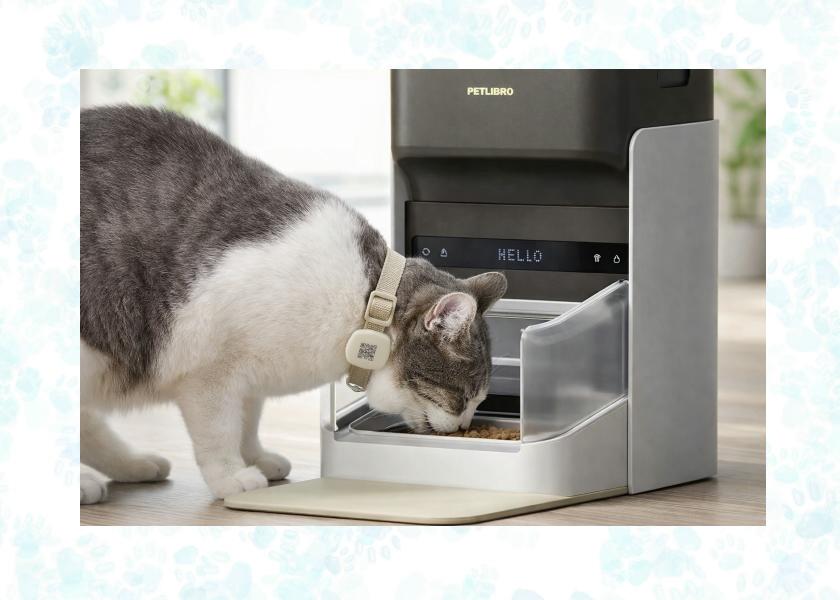
(Disclosure: This page contains affiliate links. We may earn a small commission at no extra cost to you.)
Have a Food Thief in the House? Microchip/RFID Cat Feeders are the Perfect Solution!
In multi-pet households, food theft is one of the most common causes of weight gain, digestive issues, and wasted prescription food. RFID and microchip cat feeders solve this by using your pet’s unique ID to control access to the bowl. In this 2026 update, we compare the best RFID feeders for accuracy, compatibility, capacity, and smart features.
What are the Benefits of a RFID Pet Feeder?
✅ Stop Food Theft and Create a Peaceful Mealtime
Say goodbye to the chaos of food theft! An RFID feeder for multiple cats only opens when the designated pet approaches, ensuring that your dog or cat can enjoy their meal in peace. No more policing food bowls, no more fighting over food. Just calm and stress-free feeding.
✅ Healthier Pets with Portion Control
Portion control is essential, especially for pets on weight-loss or prescription diets. These feeders ensure that each pet receives the exact amount of food they need, promoting better health and preventing overeating.
✅ Save Money on Expensive Prescription Food
We all know how frustrating it is when one pet sneaks another pet’s prescription food. RFID feeders eliminate this problem, saving you money on wasted food and potentially reducing vet bills in the future.
Table of Contents:
- How We Selected These RFID Feeders
- Microchip vs RFID Collar Tags – What’s the Difference?
- Best RFID Feeders in 2026
- Comparison Table
- SureFlap SureFeed Overview
- PETLIBRO Overview
- PawsPik Overview
- Build a Complete Smart Feeding & Hydration Setup
- FAQs
How We Selected These RFID Feeders for Cats
Choosing the right RFID or microchip cat feeder isn’t just about price or brand name. For this 2026 comparison, we evaluated each feeder based on real-world practicality and the needs of multi-pet households.
We considered the following factors:
✔ Microchip & RFID Compatibility
Does the feeder support implanted microchips, RFID collar tags, or both? We prioritized models with reliable recognition and strong compatibility with ISO-standard chips.
✔ Access Accuracy & Response Speed
How quickly does the lid open when the authorized pet approaches? Does it close securely to prevent food theft?
✔ Multi-Pet Functionality
Can the feeder store multiple pet IDs? Is it suitable for homes with more than one cat or dog?
✔ Food Capacity & Type Support
We compared bowl size, hopper capacity, and whether the feeder supports wet food, dry food, or both.
✔ Smart Features & Monitoring
App control, feeding data tracking, and alerts were evaluated for pet parents who want insight into eating habits.
✔ Power Reliability
Battery life, dual power options, and performance during outages were all considered — especially important for prescription-fed pets.
✔ Verified Customer Feedback
We reviewed consistent feedback from real pet owners regarding durability, sensor accuracy, training ease, and long-term reliability.
Each feeder on this list offers a different balance of features, making them suitable for different types of households.
Microchip vs RFID Collar Tags – What’s the Difference?
When shopping for an RFID cat feeder, it’s important to understand the difference between microchip recognition and RFID collar tag access. While both technologies control access to food, they work in slightly different ways.
🐾 Microchip Recognition (Implanted Chip)
Microchip-compatible feeders read your pet’s existing implanted microchip. Most modern feeders support standard 9-, 10-, or 15-digit ISO microchips.
How it works:
When your cat places their head inside the feeder, the built-in scanner detects the unique ID number in the implanted chip and unlocks the lid.
Pros:
- No collar required
- Nothing extra for your pet to wear
- Cannot be lost or removed
- Ideal for indoor cats who don’t wear collars
Considerations:
- Some feeders require the chip to be positioned correctly for quick detection
- Older or non-ISO chips may not be compatible
- Recognition speed can vary depending on head positioning
🏷 RFID Collar Tag Access
RFID-based feeders use a small tag attached to your pet’s collar. The feeder detects the tag’s signal and unlocks for that specific pet.
How it works:
When your pet approaches, the feeder reads the RFID tag signal and opens access to the bowl.
Pros:
- Often faster detection than microchip-only models
- Can work even if your pet doesn’t have a microchip
- Useful in homes with pets that already wear collars
Considerations:
- Requires your pet to wear a collar at all times
- Tags can be lost or damaged
- Some tags are proprietary and cannot be replaced with third-party options
🧠 Which One Is Better?
There’s no universal better option. It depends on your household:
- Choose microchip feeders if your cats are already chipped and don’t wear collars.
- Choose RFID tag feeders if you want app-based scheduling features or faster signal detection.
- In multi-pet homes with food theft issues, both systems can work effectively. Compatibility is the deciding factor.
Before purchasing, always confirm that the feeder supports your pet’s specific microchip format or that the included RFID tag suits your pet’s size and collar type.
🏆 Best RFID Cat Feeders in 2026
Comparison Table: Best RFID Cat Feeders
| Feature | SureFlap SureFeed | PETLIBRO | PawsPik |
|---|---|---|---|
| Access Method | Microchip (9, 10, 15-digit) or RFID Tag | RFID Collar Tag (No Microchip Support) | Microchip (15-digit) or PawsPik RFID Tag |
| Supports Multiple Pets? | Yes, stores up to 32 pet IDs | No, one pet per feeder | No, one pet per feeder. |
| App Control | No | Yes | Yes |
| Food Capacity | 13.5 fl. oz (wet or dry) | 3L (~2 weeks for one cat) | 16 cups (dry) |
| Power Options | Battery only | Dual power | Dual power |
| Ease of Use | One-button programming | App-controlled | App controlled |
| Price | ± $200.00 | ± $170.00 | ± $250.00 |
(Product prices and availability are accurate as of the time of publication and are subject to change. Any price and availability information displayed on Amazon or any partner site at the time of purchase will apply.)
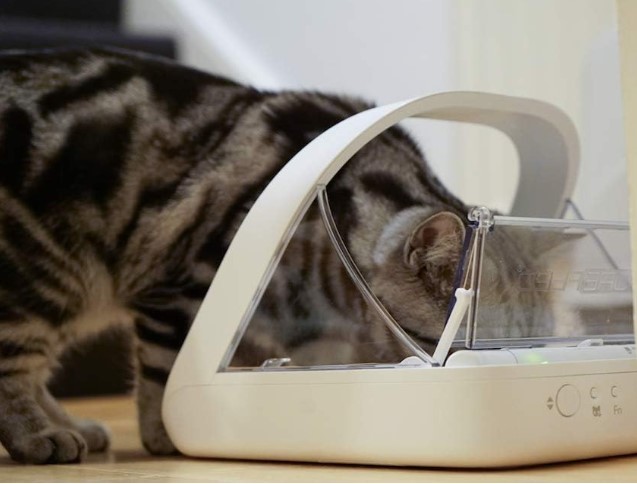
1. SureFlap SureFeed (400 ml)

✨ Key Features
✅ Microchip and RFID tag compatibility. This microchip pet feeder works with 9, 10, and 15-digit microchips or an RFID collar tag (one included). Additional tags can be purchased here.
✅ Stores up to 32 different IDs, making it great for multi-pet households.
✅ User-friendly and easy to program with a simple one-button setup.
✅ The microchip pet feeder holds 400ml of wet or dry food, and the sealed lid helps retain moisture, keeping food fresher for longer.
✅ Only opens when the assigned pet with the microchip approaches, and closes when they move away.
✅ Veterinarian recommended and backed by a 3-year warranty.
✅ Battery powered with 4 C batteries (not included) that have a 6-month life. A low-battery indicator will flash when the batteries need replacing.
👤 Who It’s Best For
- Multi-cat homes with implanted microchips — no collars needed.
- Pet parents who want simple, reliable access control without scheduling features.
- Owners of seniors or special-diet cats that stray into other bowls.
❌ Considerations
- Access method limits automation: Uses microchip/RFID recognition only — no scheduled portioning or automatic dispensing (food only opens when recognized).
- Not ideal for extended absences: Because it doesn’t schedule meals, it’s less suited for away trips compared to timed feeders.
- Capacity is modest: The bowl is adequate for mealtime but not large overnight storage.
- Training required: Cats may need patience to adapt to the lid mechanism.
💡 Tip: This feeder excels as a companion to a scheduled feeder in households where theft of specific prescription food is the main problem.
Reviews
“We have an older cat that eats slow and she’s not a piggy, the younger boy cat will eat and eat until he throws up and then he’ll eat some more. We bought this feeder for the older cat and just keep it full for her. It’s truly a life saver! Works amazingly well with her microchip. We put it up on the edge of a tall dresser for her and he cant reach around and eat while the door is open.”
“Like many reviewers, we have an old cat on prescription food and a young cat who gobbles up everything in sight. This feeder has completely solved the problem. One thing to note, however: when we first got the feeder, we programmed in the cat’s microchip number, but the feeder took so long to respond to the microchip (45-60 seconds) that I couldn’t successfully train him to use it. Solution: bought a lightweight collar and an air tag holder and switched to the RFID tag that came with the feeder. In two days, my old boy was using that feeder like a champ! Highly recommend!”
2. PETLIBRO RFID Feeder (3L)
✨ Key Features
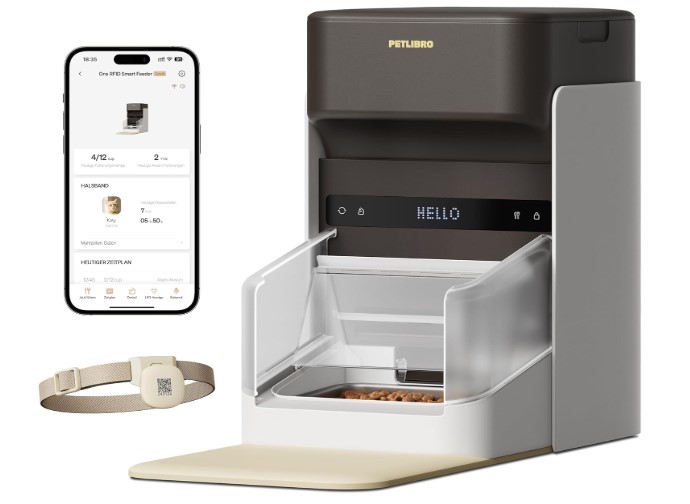
✅ Exclusive single RFID collar tag access. A lightweight collar with an ID tag is provided.
✅ Smart app control via the PawSense app (2.4G & 5G Wi-Fi). Create and modify feeding schedules, track your pet’s eating habits, and generate detailed data reports to help monitor health and spot any changes in appetite. The app is shareable up to 5 users.
✅ The 5-Layer freshness system and the extra desiccant bag work together to keep kibble fresh for longer, preventing air exposure and moisture buildup. Suitable for dry food, freeze-dried food, mixed food and air-dried food. Recommended kibble size is 2-15 mm
✅ Alerts are sent when the desiccant bag needs to be replaced, food levels are low, etc.
✅ Customizable LED screen that will sync with your pet’s name on the app.
✅ The 3L capacity can provide meals for up to 2 weeks.
✅ Set up to 10 meals per day with 1-48 portions per meal. The manual feeding option also allows you to reward your pet with extra portions when needed.
✅ Adjustable lid speed (3 settings) and you can set the closing time between 1 – 10 seconds after your pet leaves the feeder. This prevents the feeder from closing too quickly or too slowly, reducing anxiety for hesitant eaters.
✅ The sealed rotor design ensures food stays secure until dispensed.
✅ Dual power source with power adapter and 3 D batteries (not included) as backup in case of power outages.
👤 Who It’s Best For
- Owners who want remote control and monitoring via an app.
- Homes where a single cat must be separated from other pets (unique tag approach).
- People who want scheduled meal planning + real-time alerts.
If you’re building a fully connected feeding setup, PETLIBRO also offers a compatible Dockstream RFID smart water fountain that tracks hydration and syncs with the same ecosystem.
❌ Considerations
- No microchip compatibility: Requires collar tags and some cats don’t like collars.
- App & subscription quirks: Some users report connectivity issues and confusing app experiences, including possible subscription prompts for advanced features.
- Feed chute design: A few owners mention the outlet can jam with certain kibble sizes — even if rated “good” overall.
- Tag size complaints: Included tag is larger than typical ID tags, which isn’t ideal for all pets.
💡 Tip: This model is great if you want smart schedule + tracking, but check whether your cat tolerates a collar before committing.
Reviews
“We had been wanting to get another cat for a while now, but we have a special needs cat on prescription food. When I saw this, I just knew that it would be exactly what we needed! It got to us so quickly and set up was a breeze. The app is very easy to use and understand as well. Our older cat is 10 years old and had no issues adjusting to his new feeder. We have since ordered one for our new kitten as well as the RFID smart water fountain. It’s seriously so awesome to have all these insights to our pets health. 10/10 would recommend.”
“This feeder is amazing! I have four cats and only one of them has a very expensive prescription food. I have lost at least a hundred dollars on this food to other cats and my dogs. This feeder has completely changed that! He eats four times a day and I don’t have to stress out about leaving work in the middle of the day. The feeder closes slowly enough not to pinch another animals face but fast enough that I have not had to deal with any food theft. This is worth any penny especially if the food is expensive! I am getting all the benefits I wanted without paying anything extra.”
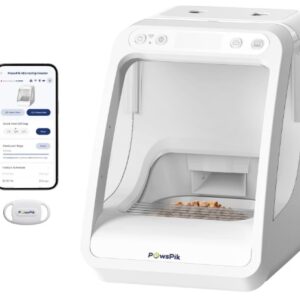
3. PawsPik Microchip/RFID Feeder
✨ Key Features
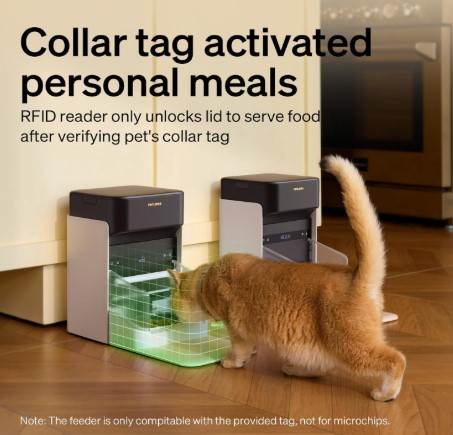
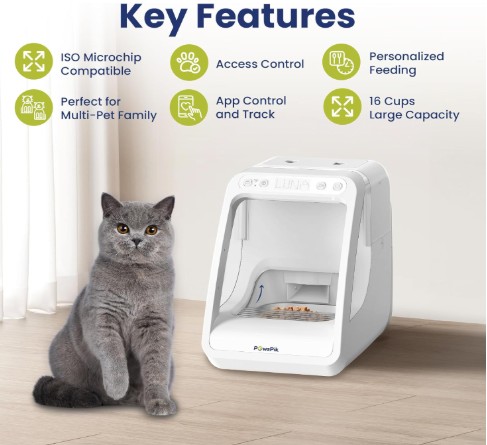
✅ Supports ISO-compliant 15-digit microchips and PawsPik RFID tags (1 PawsPik tag is included). The slim-designed tag is also splash resistant.
✅ Smart app control: Schedule up to 10 meals per day and set precise portion sizes. The app allows you to monitor feeding activity and data remotely.
✅ 2 feeding modes: Closed mode only opens for the authorized pet wearing the tag. Open mode stays open, unless an unauthorized pet approaches, then it closes.
✅ Large food capacity: Holds up to 16 cups of dry food. Best used with non-irregular sized kibbles of 8″ or less. The desiccant bag should be replaced every 1-3 months to keep food fresh.
✅ Anti-pinch sensors prevent the door from closing while your pet is close.
✅ Dual power source: AC powered for continuous daily operation and battery mode (batteries not included) in case of power outages that will last up to 3 days.
👤 Who It’s Best For
- Owners who want automatic portioning + RFID control together.
- Households with multiple cats where distinct feeding patterns matter.
- People who value rapid door response and secure access.
❌ Considerations
- Chip sensitivity varies: Some cats need the collar tag to reliably trigger recognition. Microchip reading alone may miss cats depending on head position.
- RFID tag size: Tags are a bit bulky and proprietary.
- Door mechanism feedback: Some customers find the door closes fast or isn’t adjustable, which can be daunting for hesitant eaters.
💡 Tip: If your priority is automatic scheduling + quick access, this model can be strong, but test the sensor approach with your cat’s head shape/size.
Reviews
“I’ve been using the Pawspik microchip pet feeder for a little while and it’s been great so far. The microchip recognition works really well and only opens for the right pet which completely stops food stealing. Setup was easy and the app makes scheduling and portion control super convenient. It feels well built and reliable and honestly makes feeding time much less stressful. Definitely a solid smart feeder if you have more than one pet.”
“I’ve been using this feeder for over a month, and it meets all of our needs. The RFID works great, the door is secure, and the overall build quality is excellent. Our only complaint was that the LED display was a bit too bright and somewhat annoying. However, just last week the company rolled out a software update that allows the display to be turned on or off using the buttons. So far, we’re very pleased with the purchase and impressed by a company that listens to customers feedback and responds quickly.”
Bottom Line
Whether you’re trying to prevent food theft, control portions, or monitor your pet’s health, a RFID/microchip pet feeder can simplify mealtime and promote healthier eating habits. Choose the one that best fits your needs and enjoy a stress-free feeding experience for both you and your pets!
Related Smart Feeding Guides
If you’re comparing feeding solutions, you may also find these helpful:
- Top Automatic Pet Feeders – Schedule meals, track eating habits, and manage feeding remotely.
- Best Automatic Wet Food Feeders – Designed to keep wet food fresh and portion-controlled.
- Best Wireless Water Fountains – Pair your feeder with a smart hydration solution.
Build a Complete Smart Feeding & Hydration Setup
If you’re investing in an RFID feeder to manage portion control or prescription diets, pairing it with a smart water fountain can give you even better visibility into your pet’s overall health.
Some smart water fountains now offer hydration tracking, filter alerts, and app connectivity — making them a natural companion to RFID feeding systems.
Explore our full review of the PETLIBRO RFID Smart Water Fountain to see how it integrates with smart feeding routines.
🐾 FAQs
1. How does a RFID cat feeder work?
A RFID cat feeder uses your pet’s unique microchip ID or an RFID collar tag to grant access to the food bowl. When the designated pet approaches, the feeder detects the chip or tag and opens the lid, allowing them to eat. This prevents other pets from accessing the food.
2. Can I use a RFID feeder for multiple pets?
Some RFID feeders support multiple pets. For instance, the SureFlap SureFeed can store up to 32 different microchip or RFID tag IDs, making it ideal for multi-pet households.
3. Will the feeder work if my pet has a microchip from a different country or manufacturer?
Most microchip pet feeders are compatible with standard 9, 10, and 15-digit microchips. However, it’s essential to check the specific feeder’s compatibility with your pet’s microchip type. Some feeders may require an RFID collar tag if the microchip isn’t supported.
4. How do I program the feeder to recognize my pet’s microchip or RFID tag?
Programming typically involves scanning your pet’s microchip or RFID tag using the feeder’s built-in scanner. Detailed instructions are usually provided in the user manual or quick-start guide.
5. How long do the batteries last in a RFID feeder for cats?
Battery life varies by model and usage and will depend on the number of pets and frequency of use. It’s advisable to check the manufacturer’s specifications for estimated battery life.
6. Can I use wet food in a RFID pet feeder?
Some RFID pet feeders are designed to accommodate both wet and dry food. However, it’s important to ensure that the feeder’s sealing mechanism effectively keeps the food fresh and prevents contamination. Check the user manual for guidance.
7. What should I do if the feeder isn’t recognizing my pet’s microchip or RFID tag?
If the feeder isn’t recognizing your pet’s microchip or RFID tag, ensure that the microchip is functioning correctly and that the feeder’s scanner is clean and unobstructed. Refer to the troubleshooting section of the user manual for specific guidance.
8. How do I reset the RFID feeder if it’s not working correctly?
To reset the RFID feeder, follow the reset instructions provided in the user manual. This often involves holding down a specific button for a set period. If issues persist, consult the manufacturer’s support resources for further assistance.
You might also like:
PetSmartify is a participant in the Amazon Services LLC Associates Program and other affiliate programs. We may earn a small commission from purchases (at NO additional cost to you)
Product prices and availability are accurate as of the time of publication and are subject to change. Any price and availability information displayed on Amazon or any other retailer’s website at the time of purchase will apply.